The High-Demand, High-Attrition Challenge in Critical Roles
Reading Time: 6 min
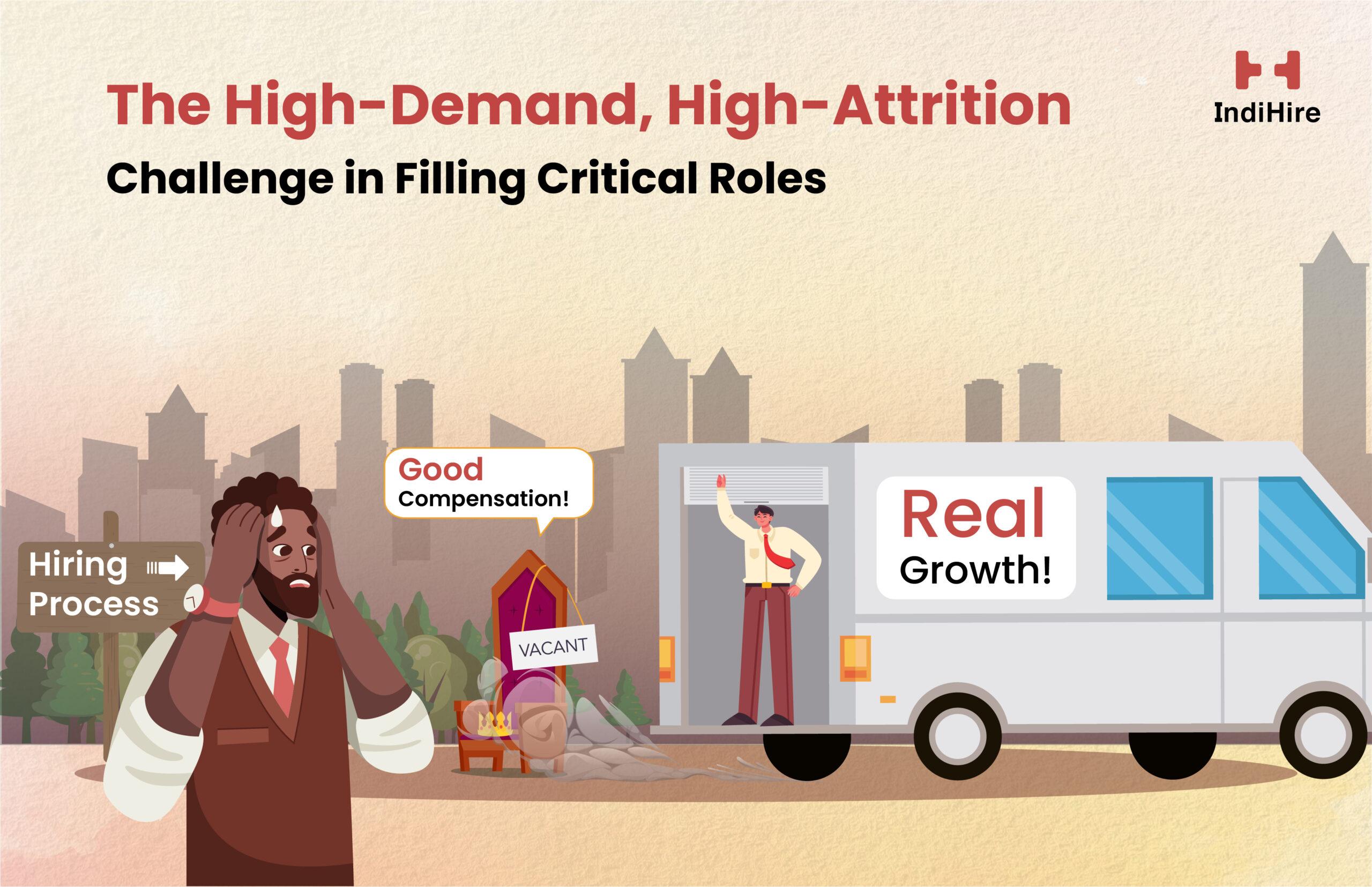
You have probably had this meeting. A key AI Engineer or a Lead Cybersecurity Analyst walk into your office and says that they are leaving. For a competitor. With a 40% salary bump, a remote-first policy, and maybe stock options too.
You sit there. Thinking, we just hired this person six months ago.
This is the new normal of talent retention in critical roles. And if you are a TA professional navigating this chaos, you already know – this is not your average attrition problem. This is something far messier, far more expensive, and far more structural.
And if you think the answer to this is “better culture”, you are quiet far from the truth.
The “Hot Role” Trap
The very act of hiring for high-demand roles like AI Governance Specialists, Autonomous Mobility Engineers, and Space Data Analysts creates a visibility problem for your talent.
Think about it. The moment “AI/ML Engineer at XYZ Organisation” appears on someone’s LinkedIn, recruiters from every corner of the industry start circling them. InMail floods in. Referral networks light up. Your freshly onboarded hire, who is still figuring out your internal structure, is already being courted by your competition.
This is the hot role paradox – the more critical the position, the harder it is to keep it filled. And unlike traditional attrition, this is not driven by dissatisfaction. It is driven by demand that simply outpaces supply.
Salary Inflation – The Retention Time Bomb
Most companies benchmark salaries at hiring. That’s it. Annual reviews nudge compensation up by 5–8%, with a slight increase for strong performers. But in the AI and cybersecurity talent market? Your competitors are offering a 20–30%, sometimes even more hikes.
So, what does that mean in practice?
Your best AI Developer, who joined a year ago, is likely being offered their current salary as a signing bonus somewhere else. And that’s a normal Tuesday in this market.
And the deeper issue is – internal pay equity discussions are almost never fast enough. By the time HR runs a compensation study, gets it through approvals, and schedules a conversation with the employee, they have already signed the offer letter.
The lag between market movement and internal correction is where you lose people. Not because you do not care. Because the machinery is not built for this speed.
The “Am I Really Doing Something Critical?” Problem
Critical tech talent increasingly wants to work on problems that matter. This is especially true for sectors like AI, data science, and cybersecurity.
And when these professionals join a company that does not have a clearly articulated strategy, they feel like they are working in an environment that does not understand what they are doing. Or worse, an environment that does not care about what they do.
They might be building sophisticated ML pipelines while leadership is still debating whether to “try this AI thing.”
The companies that are retaining critical tech talent are the ones where the CHRO and CTO are genuinely aligned on the strategic value of these roles – and where that alignment is communicated down, regularly and clearly.
But if your team thinks “Is there any real impact of what I do?”, be ready for a retention problem.
Invisible Career Paths in Highly Specialised Roles
You hire an exceptional Quantum Computing Researcher or a niche Generative AI Specialist. They are brilliant. They do great work. And six months in, they start wondering – “Where do I go from here?”
The problem with highly specialised roles is that vertical career paths are often undefined or non-existent within most organisations. You are not a generalist who can hop across functions. You are a specialist in a domain that the company barely understands from an org-design perspective.
So, when an early-stage startup offers them a “Head of AI” title with equity, even if the base is lower, they take it. Because at least there is a trajectory.
Retention for critical roles requires you to build custom career ladders. Not copy-paste versions of what worked for software engineers in 2015. Custom, role-specific, forward-looking, and co-created with the people in those roles.
The Poaching Economy and the “Cooling Off” Illusion
Some organisations respond to poaching with counteroffers. Bump the salary, promise a promotion, or add a retention bonus with a 12-month cliff. The employee stays. Leadership sighs in relief.
But the reality is that most counteroffered employees leave within 1-2 years anyway.
Why? Because the counteroffer addresses the symptom (compensation gap) but not the cause (lack of meaningful work, poor management, limited visibility). Counteroffering also makes your people feel that you only value them when they are about to leave.
The Manager Factor
In critical tech roles, the immediate manager’s technical credibility matters enormously. An AI Engineer reporting to a manager who does not understand what they do, or worse, cannot advocate for their work upward, is going to disengage fast.
This is not about personality fit. It is about professional respect and intellectual stimulation. When someone doing cutting-edge work feels like they are constantly explaining themselves to leadership rather than being challenged and pushed, the motivation erodes quietly.
Who manages your critical tech talent is as important as how you pay them.
What Actually Moves the Needle
We have diagnosed the issue. Now, here is what organisations need to do differently.
- Real-time compensation benchmarking – not annual. Quarterly market scans that are tied to automatic flagging when a role’s pay falls below the 75th percentile.
- Internal mobility as a retention tool – giving critical talent the ability to rotate across high-impact projects within the organisation before they seek that variety externally.
- Executive sponsorship for specialised teams – when a C-suite leader visibly champions the AI team, it signals that this work is core, not peripheral.
- Defined and transparent career architecture – built with the team, not handed down from HR in a PDF. Ladder frameworks that reflect what senior AI or cybersecurity mastery actually looks like in your organisation.
- Psychological safety for intellectual risk-taking – critical talent wants to experiment, fail, and try again. Organisations that punish failure are invisible to the top 10% of talent within two years.
The Uncomfortable Truth
Retaining talent in high-demand critical roles is not primarily an HR problem. It is a business strategy problem.
The organisations winning this battle are not the ones with the flashiest perks or the highest salaries (though competitive comp is table stakes). They are the ones where leadership genuinely understands the strategic weight of these roles – and builds everything from org design to manager selection to internal communication accordingly.
If your retention strategy for AI Developers looks the same as your retention strategy for Sales Associates, you are already losing.
The talent market for critical roles is not waiting for you to catch up. It is moving, constantly, and it is calling your best people right now.
The question is: what are you going to do about it before the next resignation letter lands in your inbox?


© 2026 IndiHire.