

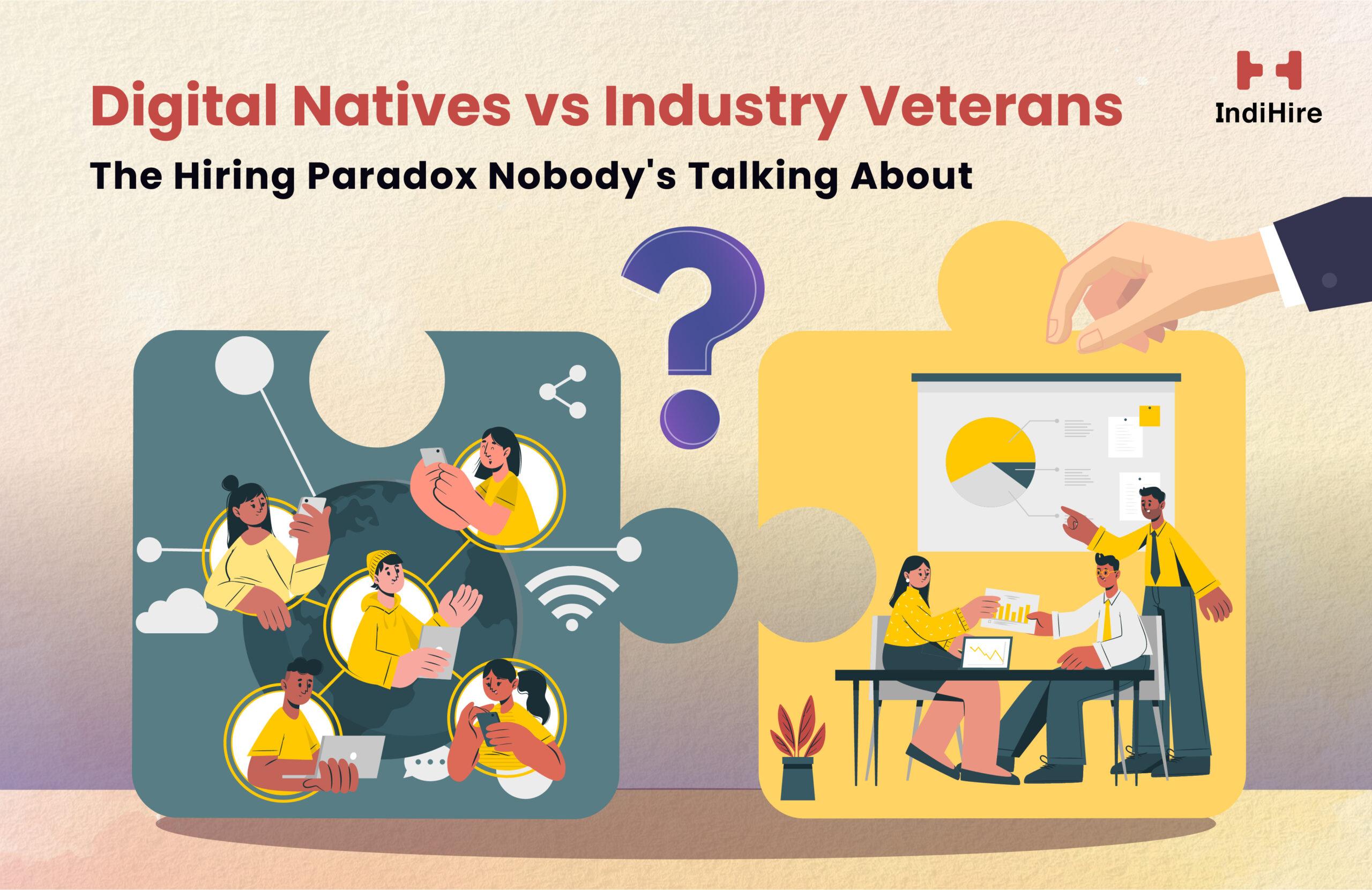
Digital Natives vs Industry Veterans: The Hiring Paradox Nobody’s Talking About
Reading Time: 7 min
Today, whenever you are hiring, you are making one of the toughest calls in modern recruitment.
Should you bet on the 24-year-old who speaks fluent Python and treats AI like a personal assistant? Or the seasoned professional who has weathered three recessions and actually remembers what business looked like before Slack notifications ruled our lives?
This is the great hiring paradox of 2026 and there is no one-size-fits-all solution.
The Real Question – Is It Just About Age?
Let’s get something straight. This is not the usual debate of “old vs young”. We have moved way past that.
Think about it. Your industry veteran brings pattern recognition that only comes from witnessing markets crash & rebuild. They have built an instinct for stakeholder management that cannot be taught in any bootcamp. But when was the last time they genuinely updated their mental operating system? Not a weekend LinkedIn Learning course. We are talking about fundamentally rewiring how they approach problems in a world where yesterday’s best practices are today’s bottlenecks.
On the flip side, your digital native? They are swimming in today’s technological ocean like it is their natural habitat. They do not just use AI tools – they think with them. But ask them to navigate a client relationship that has gone sideways, or read the room in a boardroom full of skeptical executives? That’s where the inexperience shows up.
So, what do we do? The answer depends on context – let’s break down where each type of hire truly excels.
When to Go for Industry Veterans?
Imagine launching a new product in a heavily regulated industry. Compliance matters. Relationships with regulatory bodies matter. One wrong move and you are looking at fines that could fund a whole new startup.
This is where your veteran shines. Why? Because they have been burned before. They know which regulatory bodies actually enforce which rules. They understand the unwritten protocols. They have built relationships over decades that open doors your digital native does not even know exist.
Veterans excel when:
- Risk is expensive. When failure costs millions, experience is not just valuable – it is essential. Your veteran has seen the landmines and knows exactly where they are buried.
- Relationships trump technology. In industries where deals happen over decades-long partnerships, relationships are like gold. Your digital native might have 5,000 LinkedIn connections, but your veteran has 25 people who will actually take their call at 10 PM on a Friday.
- Nuance matters more than speed. Some problems cannot be solved by moving fast and breaking things. When you are managing a merger, restructuring a department, or handling a PR crisis, you need someone who has navigated these waters before – not someone learning to swim in the deep end.
Experience is pattern recognition at scale. Your veteran does not need to Google “how to handle difficult stakeholders” because they have internalized hundreds of interactions. That intuition? It is computational power in human form.
When to Choose Digital Natives?
Now, imagine you are building a new product. Your market moves at the speed of viral tweets. Your competitors ship updates weekly. Last month’s strategy is already outdated.
Bring in the digital native.
These folks do not just adapt to change – they thrive in it. They are not intimidated by new platforms or technologies because they have been early adopters their entire lives. Remember when everyone was amazed out about ChatGPT? Your digital native was already building custom GPTs and experimenting with prompt engineering.
Digital natives dominate when:
- Speed is the competitive advantage. In fast-moving markets, waiting for perfection is waiting to die. Digital natives are comfortable with iteration, beta testing, and learning in public. They ship, learn, and adjust faster than veterans can schedule a planning meeting.
- Technical fluency is non-negotiable. If your business model depends on understanding platform algorithms, growth hacking, or leveraging emerging tech, you need people who live and breathe this stuff. It is not a skill they learned – it is their native language.
- The playbook has not been written yet. When you are entering genuinely new territory – think AI-driven business models or creator economy dynamics – historical experience is less valuable. Your veteran’s mental models might actually be a handicap. Digital natives do not have to unlearn old paradigms because they never learned them in the first place.
But here’s what rarely gets mentioned: Digital natives bring different risk tolerance. They have grown up in a world where pivoting is normal, where companies can go from garage to unicorn in 18 months. That optimism and adaptability? It is infectious. It changes team culture in ways that metrics cannot capture.
The Hybrid Model Everybody Needs
The best teams are not choosing between veterans and natives – they are building teams that leverage the benefits of both.
Your veteran product manager pairs with a digital native growth lead. The veteran brings strategic thinking and stakeholder management. The native brings technical execution and platform fluency. Together, they create something neither could alone – a strategy that actually ships, and execution that actually matters.
But this only works if you design for it. You cannot just throw people in a room and hope for magic. You need:
- Reverse mentorship programs that actually mean something. Not 30-minute coffee chats. It is about structured knowledge exchanges where the 25-year-old teaches the 50-year-old about prompt engineering, and the 50-year-old teaches the 25-year-old about reading quarterly earnings calls for competitive intelligence.
- Clarity about decision-making authority. Who makes the call when the veteran says “slow down” and the native says “ship it”? Ambiguity here kills collaboration faster than anything else. You will need someone who can listen to both arguments and make the best decision for the case.
- Cultural permission to challenge assumptions. Veterans need to feel safe admitting when they do not understand new technology. Natives need to feel safe asking “stupid” questions about industry context. Without psychological safety, you get performative collaboration – everyone nodding along while learning nothing.
The Uncomfortable Questions You Need to Ask
Before you make your next hire, try this exercise. Answer honestly:
- What kind of failure can we afford right now? If you can afford the failure of moving too slow, hire the veteran. If you can afford the failure of moving too fast, hire the native. The mistake is pretending you can afford neither, because you will get one of them.
- What is our actual learning curve capacity? Can your team genuinely teach a digital native about industry nuance? Or are you too busy firefighting to mentor properly? Conversely, can your organization actually support a veteran through meaningful digital upskilling, or will they be left to figure it out alone?
- Are we hiring for today’s problem or tomorrow’s opportunity? Veterans solve known problems efficiently. Natives create new opportunities you had not imagined. Both are valuable, but they are different value propositions.
Context is King
We would all love a simple answer. “Hire veterans for X roles, natives for Y roles”. But the truth is messier and more interesting.
The best hiring decision depends on your industry velocity, risk tolerance, organizational culture, specific role requirements, and what your existing team already looks like. If you are already heavy on veterans, that next digital native hire might create extraordinary value. If you are all young talent, adding seasoned wisdom could be transformative.
You need to understand that the tension between “we have always done it this way” and “let’s try something new” is exactly where innovation lives.
So, stop thinking about this as a binary choice. Start thinking about it as portfolio construction. What mix of experience and digital fluency does your team need to win in your specific market, with your specific challenges, right now?
Because the market is not waiting for you to figure this out. And neither is your competition.


© 2026 IndiHire.