

Future-Proofing Leadership Pipelines Before the Crisis Hits
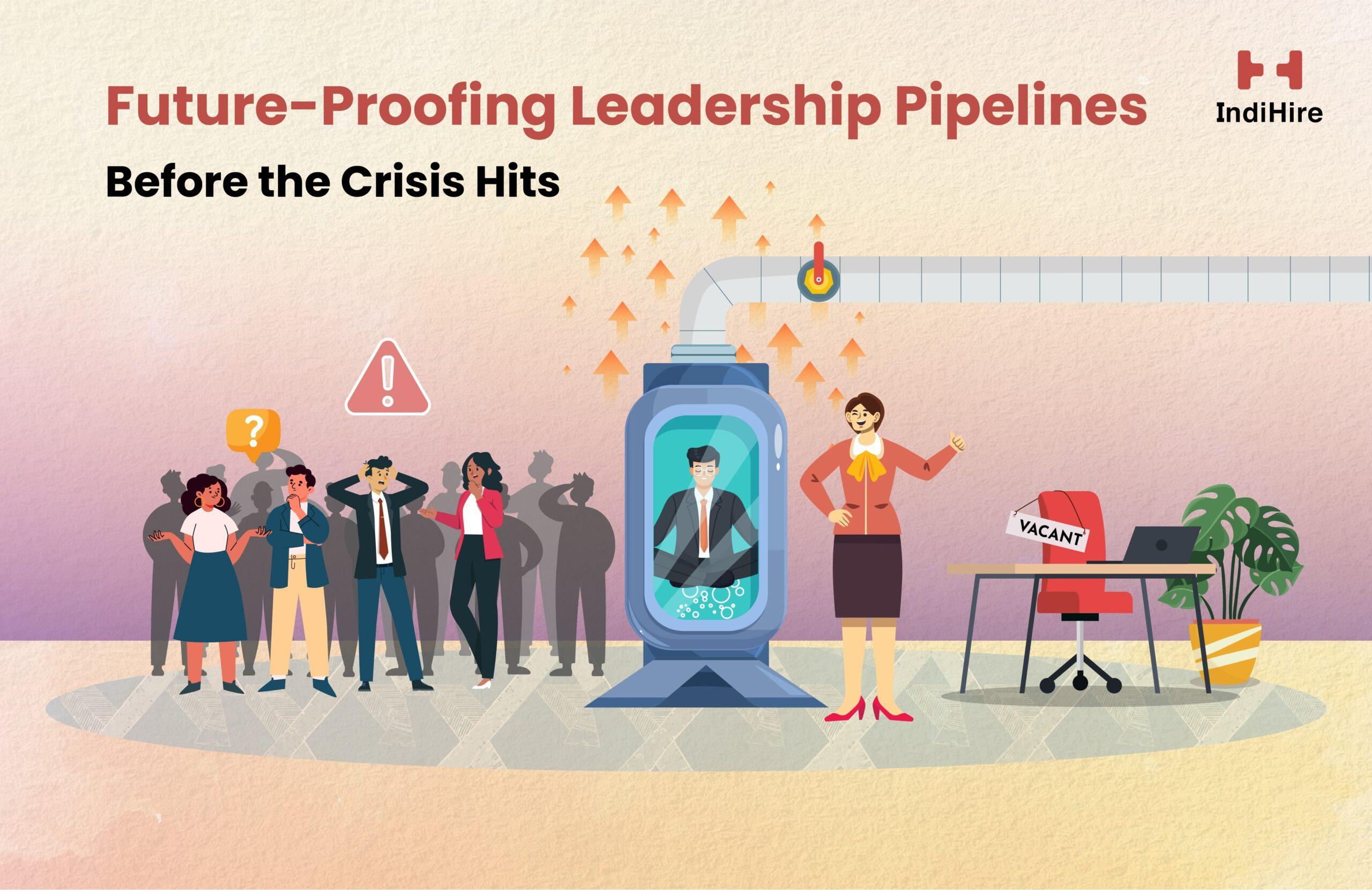
Reading Time: 6 min
Most organisations do not start thinking about leadership succession until someone hands in their resignation, announces a retirement, or gets poached by a competitor. And then what happens? Panic. Emergency calls. The situation looks a lot like trying to build a parachute on the way down.
If you are a recruitment professional who has been through this before, you already know the pain. Finding the right leader is not like filling a mid-level role. You cannot just post a JD on LinkedIn, screen a few profiles, and call it a day. Leadership hiring is a completely different scenario.
And that’s exactly why you need a leadership pipeline that’s already running long before a crisis knocks on your door. Not as a backup plan. As a strategic advantage.
Because waiting for a leadership vacuum to appear is the organisational equivalent of googling ‘how to swim’ mid-ocean.
The Leadership Gap
Here’s a question: Do you actually know who in your organisation is ready to step up – not just capable on paper, but genuinely ready to handle the specific pressures your business is navigating right now?
Not ‘ready in theory.’ Ready for the reality – expansion into a new geography with a half-built team, managing a business unit under financial pressure, or leading through a restructure that nobody has fully signed off on yet.
Most talent assessments do not go there. They measure competencies, run personality profiles – but they rarely stress-test people against the specific, live, messy context of your organisation. That’s a huge gap.
‘We’ll Cross That Bridge When We Get There’ is Failing
A typical C-suite or senior leadership search takes four to six months at a minimum. Add another three to six months for the person to come up to speed, build trust, and start making real decisions. You are now looking at close to a year before the genuine impact kicks in.
And that’s if you hire right on the first attempt.
If you do not? You are back to square one. Except now you have lost time, spent budget, potentially disrupted a team, and created uncertainty that ripples further than most leaders care to admit. Turnover in leadership positions does not just affect one role – it affects morale, momentum, and sometimes even client confidence.
This is why reactive leadership hiring is not just inconvenient – it is strategically dangerous.
What a Real Leadership Pipeline Actually Looks Like
It is not about a spreadsheet with a few names and a ‘high potential’ tag on them. A functioning pipeline is a living system. Here’s what it actually involves:
- Scenario-mapped readiness assessments: Not just ‘is this person leadership material?’ but ‘is this person ready to lead through our next acquisition, our market entry into the Middle East, or our product pivot?’ Generic potential tags are flattering but useless. Context is everything.
- Intentional exposure, not just tenure: A lot of organisations confuse time-in-role with readiness. The person who has been around for eight years is not automatically your next VP. But the person who has been stretched across cross-functional projects, navigated a difficult stakeholder environment, and delivered under ambiguity? That is a different story.
- External benchmarking alongside internal development: Your pipeline should not be a closed ecosystem. Knowing what exceptional leadership looks like in the market – what skills and profiles are emerging, what is becoming obsolete – helps you calibrate who you are developing internally and when you may genuinely need to go external.
- Honest succession conversations at the senior level: This one is awkward, and that is probably why it gets avoided. But boards and leadership teams that never discuss succession are essentially saying, ‘We will figure it out when someone leaves.’ That is not a strategy. That is optimism dressed up as one.
The Hidden Risks
Here’s something that does not always make it into the slide deck: leadership pipeline failures compound.
When you do not have a ready successor for a critical role, one of two things typically happens. Either you promote someone before they are ready – and they struggle visibly, which chips away at team confidence – or you go external and bring in someone who does not yet understand the nuances of your organisation, and they struggle invisibly for months before anyone will admit it is not working.
There is also a third, less-discussed risk: your high-potential people leave because they can see there is no path forward.
If your best internal candidates do not feel seen or developed, they will go find an organisation that will do that work for them. And then your external pipeline becomes your only pipeline – which is expensive, slow, and risky.
Building the Pipeline – Where to Actually Start
The good news is that you do not need a multi-year programme with a consultant-led overhaul to start building something meaningful. You need clarity and consistency, applied over time.
Start with three honest questions:
- Which three to five roles, if vacated tomorrow, would genuinely put the business at risk?
- For each of those roles, do we have an internal candidate who is 70% ready – or are we completely exposed?
- What is the one development move – a stretch assignment, a rotation, a sponsorship – that would close that gap for our top candidate in the next 12 months?
If you can answer those questions clearly and honestly, you have already started. If you cannot, that itself tells you where the urgent work is.
The Conversation That Actually Needs to Happen
For talent acquisition professionals reading this, the leadership pipeline conversation is partly yours to own, but it does not live only with HR. If your senior leadership team is not actively involved in identifying, sponsoring, and developing the next generation of leaders in their own functions, you are doing the work with one hand tied behind your back.
One of the biggest mistakes organisations make is treating succession planning as an HR exercise that gets reviewed once a year and filed away. It needs to be a live business conversation – as regular and as consequential as a quarterly performance review.
Push for visibility. Push for accountability. And when a leadership role opens up, you want to walk into that room with options – not a blank page.
The Bottom Line
The organisations that get leadership right are not lucky. They are prepared. They have had the uncomfortable conversations, done the honest audits, and made development a consistent priority – not a reactive measure.
You do not future-proof a leadership pipeline in a crisis. You build it before one arrives, so that when the inevitable moment comes, you are not scrambling. You are ready.
So, here’s the real question: if your most critical leader walked out tomorrow, what would your next move be?
If you are not entirely sure, that is the answer telling you where to start.


© 2026 IndiHire.