

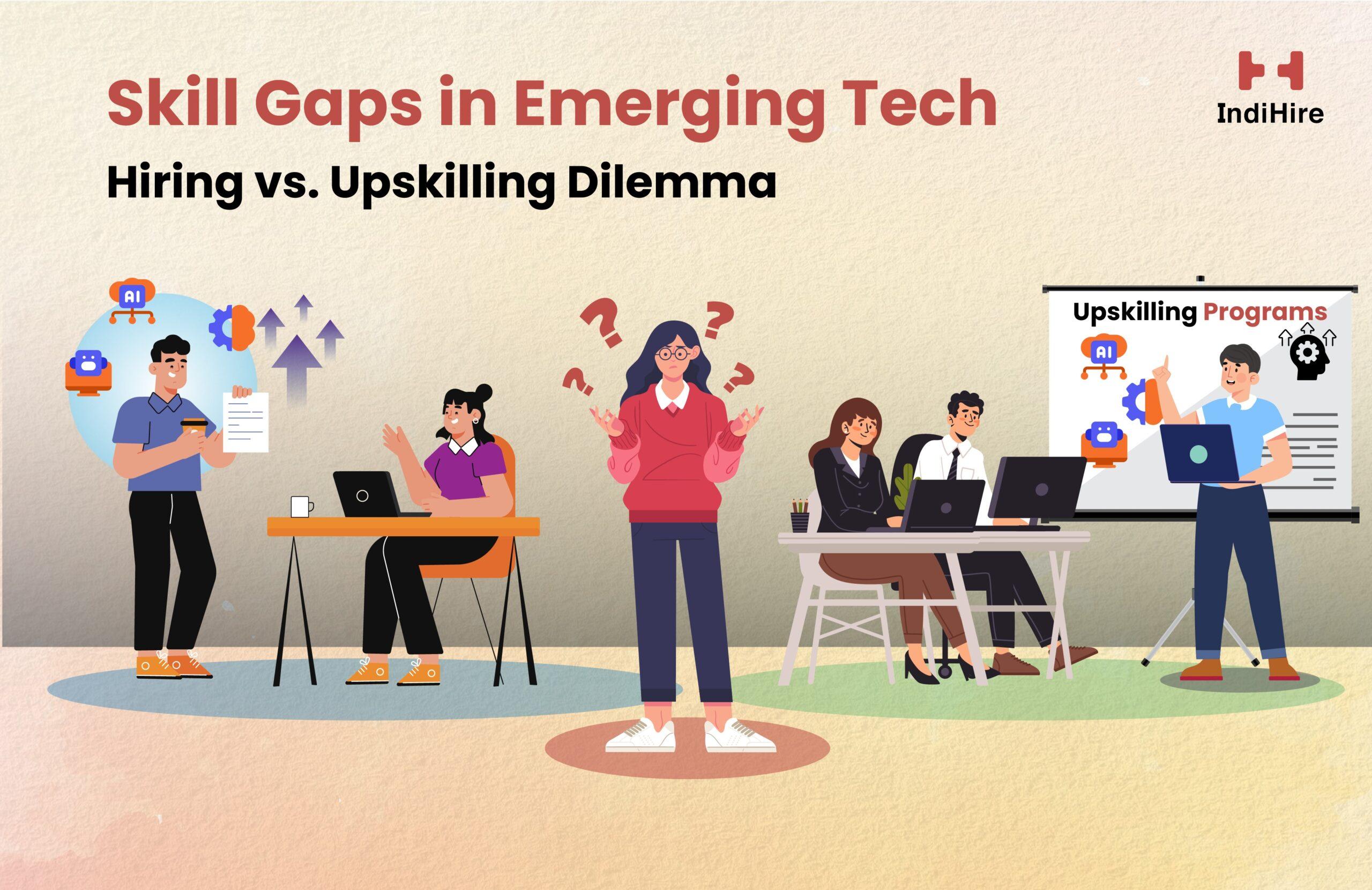
Skill Gaps in Emerging Tech: The Hiring vs. Upskilling Dilemma
Reading Time: 7 min
If you have tried to hire an AI engineer, a ML specialist, or even a solid data scientist in the last 18 months, you already know the pain. The talent pool is not just shallow – it is a kiddie pool where everyone wants to swim.
This is the emerging tech skills crisis, and it is creating a genuinely uncomfortable hurdle in the road for TA professionals.
Do you hire externally and drain your budget chasing talent that might leave in eight months anyway? Or do you upskill your existing workforce and risk falling behind while competitors are already three steps ahead?
Neither answer is clean. Both have landmines. Let’s delve into what makes sense and when.
The Talent Market Is Broken
The truth is that the market for emerging tech skills is not yet a functional market. It is a full-blown bidding war.
AI/ML engineers are commanding salaries that make CFOs sweat in board meetings. Average tenure for top-tier data and AI talent is dropping – not because people are unhappy, but because they are getting unsolicited offers every other week. And with the rise of AI-native startups, the competition is not just your industry peers. It is every industry, every company, every geography – all fishing in the same pond simultaneously.
So, before you default to “let’s just hire our way out of this,” ask yourself: Is that actually a strategy, or is it panic with a job description attached?
When External Hiring Actually Makes Sense
External hiring is the right call in specific, well-defined scenarios – not as a reflexive response to a skills gap.
Hire externally when:
- The skill is genuinely rare, and the timeline is non-negotiable. If your board has mandated an AI product launch in six months and you have zero internal capability, you do not have the time for an upskilling program. You need someone now.
- You need a technical anchor – not a team. One or two expert hires can serve as internal coaches and standard-setters. The goal is not to fill every AI role externally – it is to hire the person who can build the internal capability around them.
- The role requires lived, battle-tested experience. Some things genuinely cannot be taught fast enough. Security architecture for AI systems, for example, is not a six-week online course situation.
But here’s what most companies get wrong: they hire externally and then create no retention infrastructure around that hire. No growth path, no ownership, no community of peers. And then they are shocked when that person leaves for a company offering 20% more and an equity package that actually means something.
The fix? Before you post the job, map out what keeps this person engaged at month 6/12/18. If you cannot answer that, the hire will cost you twice – once to recruit, once to replace.
The Upskilling Case Is Stronger Than You Think
Here’s where the industry conversation often gets lazy. “Upskilling” gets thrown around like it is a magic word – sprinkle some LinkedIn Learning licenses on people, call it a learning culture, done. That is not upskilling. That is wishful thinking with a subscription fee.
Upskill when:
- The capability gap is wide but not immediate. You have 9-18 months of runway? Use it.
- You have existing employees with strong domain knowledge who simply lack the technical overlay. Domain knowledge + new tech skills is often more valuable than pure technical talent who does not understand your business.
- Retention and culture are strategic priorities. People who are invested in and grow within a company are significantly more loyal than external hires who came for the salary.
But real upskilling in emerging tech requires three things most companies skip.
1. Brutally Honest Skills Mapping
Not a survey. Not a manager’s hunch. Actual skills adjacency analysis. Who in your org is closest to the capabilities you need? A Python-savvy data analyst is not an AI engineer, but they are a lot closer than a project manager with enthusiasm. Find your adjacent talent and build from there.
2. Learning Tied to Real Work, Not Hypothetical Projects
The fastest way to kill an upskilling initiative is to make people learn in a vacuum. If your finance analyst is studying ML, give them a real business problem to apply it to. Learning without application is just expensive forgetting.
3. Time Protection
This one is almost always overlooked. Companies announce upskilling programs and then never actually give people time to learn. If your employees are expected to hit their regular KPIs and upskill in emerging tech, something will be lost. And in most cases, it is the learning.
The Hybrid Model – Hire to Teach
Here’s a thought that does not come up enough: hire externally, but specifically to multiply internal capability.
This means hiring senior AI talent not just to do the work, but to actively build the team around them. Embed an expectation of knowledge transfer in the job description itself. Suddenly, your external hire is not just a short-term solution – they are a catalyst for long-term organisational capability.
This also changes who you are recruiting. You are not just looking for the most technically brilliant person. You are looking for someone who is technically brilliant and genuinely enjoys mentoring. Often, a slightly less headline-grabbing hire who loves building teams will create 10x more value than a solo superstar who hoards knowledge.
The Decision Framework You Actually Need
Stop thinking about hiring vs. upskilling as a binary. Start thinking in terms of speed, depth, and sustainability. The honest answer for most companies?
You need both, in the right ratio, with the right infrastructure around each.
Hire the anchors. Upskill the adjacent talent. Build retention structures for both. And give your learning programs actual time, resources, and real consequences for not supporting them.
Let’s compare hiring externally vs upskilling internally in various factors.
Speed to Productivity
If you have an urgent project that you need to push in the coming 6-12 months, external hires are the best way to go as they can hit the ground running, while internal upskilling will take time, maybe even more than 6 months for newer, more critical skills.
Long Term Retention Risk
In today’s market, if you hire someone for a critical skill, they are likely to be approached by other companies that are offering more money, more flexibility, etc., whereas upskilling has been proven to enhance retention in existing employees.
Cultural Fit
While hiring for emerging skills, you cannot focus too much on cultural fit, as these professionals are already comparable to unicorns. But your existing employees already know your culture and will appreciate it even more when given proper upskilling opportunities.
A Final Thought
The companies that are going to win the emerging tech talent race are not necessarily the ones with the biggest hiring budgets. They are the ones who figure out how to make upskilling feel exciting within their own walls.
When employees see a clear pathway – from where they are today to where the organisation is going – they stop taking calls from recruiters. That is not idealism. That is a strategy.
So, the next time your board asks what you are doing about the AI skills gap, do not just show them a headcount plan. Show them an ecosystem. One that attracts great talent and grows it from within.


© 2026 IndiHire.