

From Recruiters to Talent Advisors – The Evolution of Talent Acquisition
Reading Time: 6 min
Talent acquisition has undergone one of the most dramatic reinventions in modern business. And yet, most people have not noticed it.
When asked before, “What does a recruiter do all day?” What came to mind was – sourcing candidates, scheduling interviews, and negotiating offers. But today, it has evolved further.
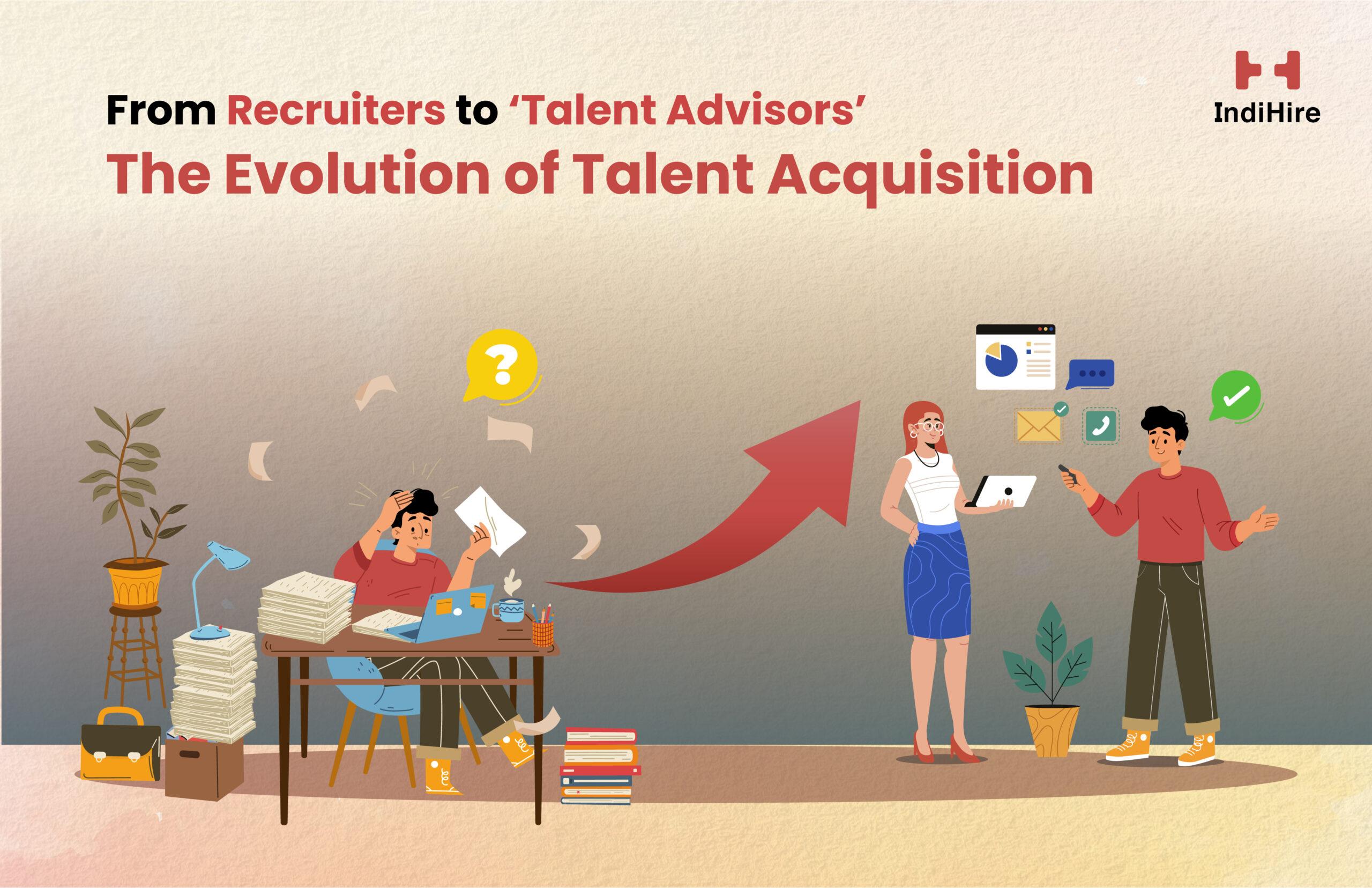
In reality, talent acquisition has grown up. Quietly, the function has evolved from a reactive, administrative process into something far more strategic. And at the centre of this transformation is the recruiter – now rapidly evolving into something much more consequential: the talent advisor.
But, before we talk about where we are going, we need to be honest about where we have been.
How Recruiting Used to Work
Not long ago – think five to seven years back – the typical recruiter operated almost entirely in reactive mode. A hiring manager would raise a requisition, the recruiter would post a job, screen the flood of applications, schedule interviews, manage the offer, and move on to the next open role. Repeat. Hire. Repeat.
The function was transactional by design. Recruiters were evaluated on time-to-fill and cost-per-hire, metrics that rewarded speed over quality and volume over strategy. There was little room for recruiters to shape the conversation around who the business actually needed to hire, or why.
Hiring managers held most of the cards. They defined the role, set the criteria, and often made the final call with minimal pushback. The recruiter was, in many ways, a glorified logistics coordinator. Not because the people were incapable, but because the system was not designed to use them differently.
And then the world shifted.
Remote work exploded the talent pool. Skills-based hiring started challenging degree requirements. The great resignation revealed just how quickly organisations could lose their competitive edge when talent strategy is an afterthought. Then, AI automated half the administrative workload and suddenly, there was space for recruiters to do more.
From Order-Takers to Talent Advisors
Here’s the thing about the recruiter-to-talent-advisor shift – it is not just a title change or a rebrand. It is a fundamental repositioning of what value looks like in the talent function.
Challenging the Job Description Before the Search Begins
One of the most undervalued skills a modern talent advisor brings to the table is the ability to interrogate the brief.
A recruiter takes a job description and goes to market. A talent advisor reads that same JD and asks: “Does this actually reflect what this team needs to succeed? Or is it a wish list?”
This is not about being difficult. It is about understanding that most hiring failures do not happen at the offer stage – they happen in the first conversation, when the role is poorly defined and misaligned with organisational reality. Talent advisors sit with hiring managers early, push back on inflated requirements, help reframe must-haves versus nice-to-haves, and ensure the search is calibrated to the actual market.
When your talent advisor tells a hiring manager, “This combination of skills at this salary band does not exist in this city,” that is not pessimism. That is market intelligence. That is strategy. And it saves months.
Becoming the Organisation’s Eyes and Ears on the Talent Market
Traditional recruiters reported on pipelines. Talent advisors report on markets.
There is a difference. A pipeline tells you where your candidates are. Market intelligence tells you where the talent is moving, what competitors are paying, which skills are becoming scarce, and what candidates in your target segment actually care about right now.
This shift means talent advisors are now conducting what you might call ongoing talent market research – not just when a role opens, but continuously. They are tracking talent density by geography, monitoring competitor hiring patterns, mapping out emerging skill adjacencies, and feeding that insight into workforce planning conversations months before a requisition is even raised.
Redefining Success Metrics and Making the Case Internally
This one is harder than it sounds, because it requires challenging some deeply entrenched habits.
When a recruiter is measured purely on speed and cost, that is exactly what the organisation optimises for. But speed without quality is just expensive churn. Recruiters are increasingly leading the conversation around what should actually be measured and pushing for metrics that reflect long-term value. These metrics include hiring manager satisfaction, new hire performance at 6 and 12 months, retention rates at the one-year mark, and quality-of-hire scores.
Owning Candidate Experience as a Brand Function
Here’s where things get interesting and where a lot of organisations are still behind.
Every candidate who interacts with your organisation leaves with an impression. That impression does not stay private. It shows up on Glassdoor, in LinkedIn comments, in conversations at industry events, and in referrals. Candidate experience is employer brand in action, and recruiters understand this deeply.
What separates a modern recruiter from a traditional recruiter here is not just empathy – it is intentionality. Talent advisors design the experience. They think about touchpoints, communication rhythm, feedback loops, and how rejections are handled. They ask: “Would I recommend applying here to a friend, based on what I just put that candidate through?”
The organisations with the strongest employer brands did not get there by accident. They got there because someone in the talent function decided to treat every candidate interaction as a brand moment and built systems around that belief.
Building Talent Communities, Not Just Pipelines
Traditional recruiting was transactional: open role, find candidate, close role, forget candidate. Talent advisory is relational: build relationships at scale, stay relevant to talent communities, and be the organisation people think of when they are ready to move – not just when you are ready to hire.
This is a subtle but profound shift. It means recruiters are nurturing passive talent over months and years. They are maintaining relationships with silver-medal candidates who were not right for one role but might be perfect for the next. They are building presence in talent communities like industry groups, alumni networks, and professional communities, long before a hiring need arises.
Think of it less like fishing with a rod and more like building an ecosystem. It takes longer to set up. But when the time comes, you are not starting from zero.
What Does This Mean for TA Leaders?
For TA leaders, the question is not whether this evolution is happening. The question is whether your team is being set up to lead it or being left behind by it.
That means investing in the skills that make this shift possible: business acumen, data literacy, stakeholder influence, and market research capability. It means redesigning how you measure the function. And it means giving your recruiters the space, the mandate, and the credibility to operate as advisors, not order-takers.
Because the truth is that if AI is handling resume screening and interview scheduling, and your recruiters are still being evaluated on how fast they fill roles, you have automated away the transactional work but kept the transactional mindset. That is not transformation. That is just efficiency.
If you want to win the next decade of talent competition, then position your recruiting function as a strategic intelligence unit, one that shapes workforce decisions before they become workforce problems.


© 2026 IndiHire.