

Interview Fatigue – The Problem Nobody Quantifies
Reading Time: 7 min
A strong candidate makes it to the final round. They have nailed every conversation. And then, on the last call, something is just… off. They seem flat. Their answers are technically correct but hollow. The spark is gone.
The hiring manager walks away unconvinced, the offer does not go out, and two weeks later, you watch that same person announces a new role on LinkedIn – somewhere that interviewed them in two rounds instead of six.
What happened? Interview fatigue! And it did not show up in any of your dashboards.
We track time-to-hire, offer acceptance, and pipeline conversion. But nobody is measuring the slow burnout that happens when the process itself wears everyone down.
Interview fatigue sits in a strange blind spot: everyone knows it exists, most people have felt it personally, and yet it almost never appears as a line item in any talent analytics report.
The Candidate’s Quiet Unravelling
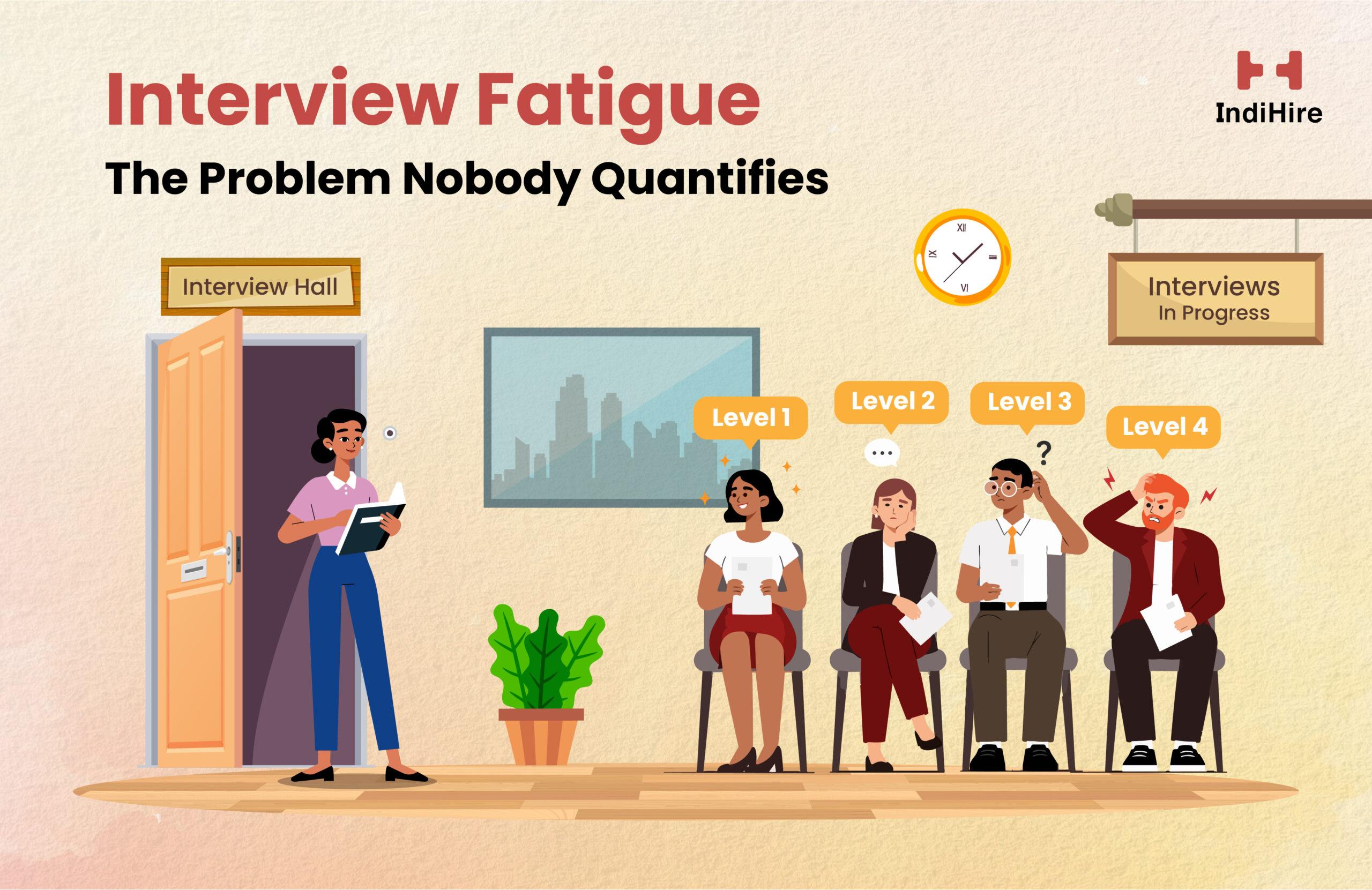
By the time a candidate reaches round four or five of your process, they are not performing at their best anymore. They are performing at the best they can manage while also doing their current job, managing their anxiety about the outcome, prepping for each new interviewer’s slightly different framing of the same question, and pretending to the world that everything is fine.
The candidate who seems disengaged in round five might simply be the candidate who ran out of performative enthusiasm – not passion for the role.
The Persona Drift
The less-discussed dimension here is what we might call persona drift. Over the course of a long interview process, candidates unconsciously start calibrating their answers to match what they think each interviewer wants to hear.
By round five, they are no longer quite sure which version of themselves is the real one. The responses become rehearsed, safe, and generic – which then reads as a lack of depth or conviction. The hiring team things of this as a shortcoming, while the candidate just needed it to be over.
There is also the calendar asymmetry problem. Your interview process runs on your timeline. But the candidate is fitting your six-week process into a life that has not paused for them – a current employer, a partner, maybe kids, EMIs that do not care how many rounds remain.
Recruiter silence during long gaps between stages is not neutral. It reads as disinterest, and candidates begin mentally decommitting from the process. When they finally re-engage for the next round, they are doing so with fractionally less investment than before.
Multiply that across five stages, and you are left with a candidate who started the process excited and ends it merely compliant.
The Interviewer Side That Nobody Talks About
Now flip the lens. Because the recruiter and hiring panel are not immune to this either – they are just expected to pretend otherwise.
Imagine your senior engineering manager has back-to-back candidate loops every Tuesday and Thursday for six weeks of an active search. By week four, something quietly shifts. The energy they brought to the first candidate – genuine curiosity, open-ended questions, enthusiasm about the role – starts to compress into a tighter, more procedural experience.
Not because they stopped caring. Because the human brain was not built to make high-stakes evaluative decisions at scale without deterioration in quality.
The Cost Nobody Measures
Interviewer fatigue is not just about being tired. It produces a specific cognitive pattern: interviewers begin pattern-matching to candidates they have already seen rather than evaluating the person in front of them.
The result is a bias toward familiarity, which often means bias toward candidates who remind them of earlier, positively-rated candidates, who may or may not resemble the actual hire profile you need.
This is not a character flaw. It is neurological housekeeping. The brain defaults to shortcuts when the load is too high.
There is also a subtler cost. Interviewers who conduct too many rounds without structured debrief rituals start to homogenise their feedback.
Individual observations get averaged toward a consensus. Individual impressions – the ones that are sometimes the most valuable signal – get quietly dropped. It is because articulating a specialised view is exhausting when you have already been in three interviews that day. The output is a hiring decision that feels safe rather than sharp.
The Structural Problems
Most interview processes were not designed. They accreted. A founder once did four rounds because they were nervous about their first hire. That became the template.
Years later, a 2,000-person company is running a six-stage process for a mid-level individual contributor role because “that’s just how we do it here,” and nobody has ever had the will to dismantle it.
So let us name a few of the specific structural problems that are easy to fix once you admit they exist.
- Redundant rounds where multiple interviewers are assessing identical competencies with no coordination, producing noise rather than signal.
- No inter-rater calibration, so a “strong yes” from one interviewer and a “weak yes” from another carries the same weight in the final debrief.
- Unstructured gaps between stages leave candidates in informational limbo, silently eroding their interest.
- When Interview panels are formed based on availability rather than necessity, no one has clear idea of what they are evaluating.
- Asynchronous video assessments stacked on top of existing live rounds rather than replacing them, adding workload for both sides without adding clarity.
Each of these sounds minor in isolation. Collectively, they build a process that extracts maximum effort from everyone involved while returning minimum insight. That is a bad return on investment and a significant reason why strong candidates withdraw mid-process.
What Actually Works?
The usual advice – “streamline your process”, “give feedback faster”, “respect the candidate’s time” – is all correct and all ignored. So, what are others doing that make them avoid interview fatigue altogether? Let’s find out.
Competency Mapping with Exclusivity Built In
Each interviewer owns a specific, non-overlapping slice of the evaluation. When someone owns a domain exclusively, they prepare better, ask better questions, and produce more useful signals. It also makes debrief conversations crisper because every person in the room has genuinely different data.
Stage-Gate Reviews with Defined Exit Criteria
Rather than running a linear multi-stage process regardless of signal quality, high-performing TA teams define what a “clear yes” looks like at each stage – and if they have it, they compress the remaining rounds. The process serves the decision, not the other way around.
Deliberate Pacing, Not Just Faster Pacing
Speed matters, but so does rhythm. There is a real case for a structured 48-hour gap between key stages – long enough for both sides to process and prepare meaningfully, short enough to preserve momentum. The enemy of great hiring is not a 48-hour gap. It is a silent 12-day gap preceded by no acknowledgement of the delay.
Interviewer Rotation and Load Caps
Some companies have started capping how many interviews a given team member can conduct per week during a search. This sounds radical until you ask yourself how many bad hiring decisions have been made in back-to-back Friday afternoon debrief calls.
The Measurement Gap
If you are serious about reducing interview fatigue in your hiring process, here is how you start. Pull your stage-by-stage drop-out data and cross-reference it with process length. Look at your interviewer feedback scores across early versus late stages in long searches. Ask your most recent declined candidates in exit surveys about what their experience of the process length felt like.
You will find the fatigue. It is there. You just have not been looking at it systematically.
The companies that treat interview experience as a product to be designed – not a process to be inherited – are consistently outperforming on offer acceptance, candidate quality, and interviewer satisfaction and retention on the hiring team itself.
It turns out that conducting purposeful interviews in a well-designed process is genuinely energising. The exhausting version is the poorly structured one.
Fix the process, and the fatigue largely fixes itself. But first, you must decide if it is worth measuring. And that decision starts here.


© 2026 IndiHire.