The Skills Graph: Mapping Capabilities Beyond Resumes
Reading Time: 4 min
It’s peak hiring season, a hiring manager scans through yet another resume, and his eyes fall on something substantial – impressive companies, solid titles, and clean formatting that catches the eye in one go. On paper, this candidate looks like the perfect fit. And yet, something feels off about them. Because resumes are great at telling you what they have done in the past, but not always what they’re truly capable of.
This gap between resumes and the actual skills the person possesses is becoming impossible to ignore in today’s hiring landscape. So, the real question is – are we still hiring based on just documents in a world that demands dynamic capabilities?
It is not just a trend anymore, but a much-needed shift in understanding what ‘talent’ actually is.
What Is a Skills Graph And Why Does It Matter
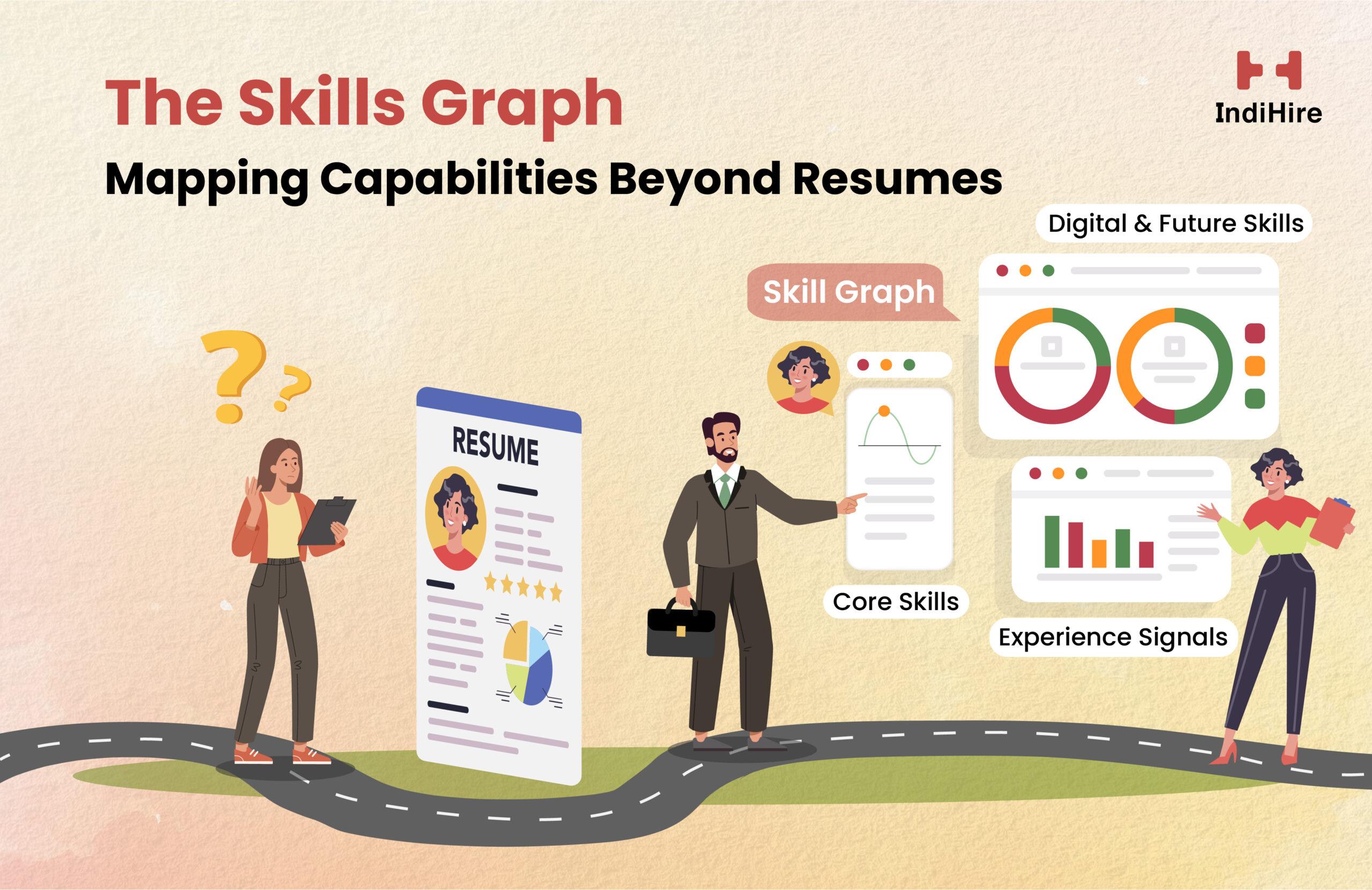
Think of a resume as a snapshot. A skills graph, on the other hand, is a heatmap.
While a resume only shows what a candidate has done in their career past, a skill, however, connects the dots between their past experiences, skills they might have acquired, behaviours, potential, capabilities, and possibilities about what more they could do. It looks at how different capabilities interact, evolve, and translate into real-world performance.
In a world where roles are constantly shifting, this deeper understanding is not only helpful, it is much needed as well.
The Problem with Resume-First Hiring
Let’s be honest! Resumes have always been a bit of a highlight reel. Carefully curated, slightly polished, and sometimes, strategically created.
But the bigger issue is not the exaggeration. It is a limitation.
Resumes often fail to capture real & soft skills like – how someone thinks under pressure, how they collaborate in unfamiliar teams, or how they adapt when things do not go as planned. In other words, they miss the essential elements that define long-term success.
This becomes even more critical in modern workplaces where hiring is not just about filling a role, but more about building a team that can evolve, adapt, and grow together.
So, when we rely only on resumes, we are not just missing information; we are making decisions with incomplete data.
Looking Beyond Credentials: The Right Hire
The real difference between a good talent and the right hire lies beyond what the resume holds.
Behaviour Over Bullet Points
If resumes don’t tell the full story, then what does?
The answer: a combination of skills, behaviours, and patterns. A candidate’s ability to solve problems, communicate clearly, and navigate uncertainty often matters more than the exact tools they have used before.
Potential Over Past
Some of the most successful hires are the ones who show the ability to learn, adapt, and think differently, rather than just ticking all the boxes in the checklist.
Looking at this, one thing is sure: hiring has shifted from “Have they done this before?” to “Can they figure this out moving forward?”
How to Start Building a Skills Graph in Your Organization
Understanding the concept is one thing, but implementing it effectively is where it truly matters.
Move from Static to Dynamic Evaluation
Building a skills graph does not require reinventing your entire hiring process, but simply rethinking and redefining it.
Structured problem-solving exercises, behavioural interviews, and real-world simulations can reveal far more than resumes ever will. They show how candidates think, react, and adapt in real time, pressure or no pressure.
Use Technology – But Keep It Human
While AI-driven tools and skill-mapping platforms can help identify patterns, it is crucial to ensure that they ‘support’ decisions, not exactly ‘make’ them.
Because at the end of the day, hiring is still about people – not just profiles.
The Business Impact of Skills-Based Evaluation
When you shift from resumes to skills graphs, hiring becomes more than a process – it becomes a strategic advantage.
Organizations begin to see talent as evolving capabilities rather than fixed roles. This unlocks:
- Better internal mobility
- Stronger team alignment
- Higher retention through meaningful growth
And most importantly, it builds a workforce that can adapt to change – instead of being disrupted by it.
Hiring for What’s Next, Not What’s Done
So, the shift is clear: look beyond credentials, ask better questions, and focus on what truly drives performance. Because the best hires aren’t always the ones who look perfect on paper – They’re the ones who grow into something even better once they’re in the room.


© 2026 IndiHire.