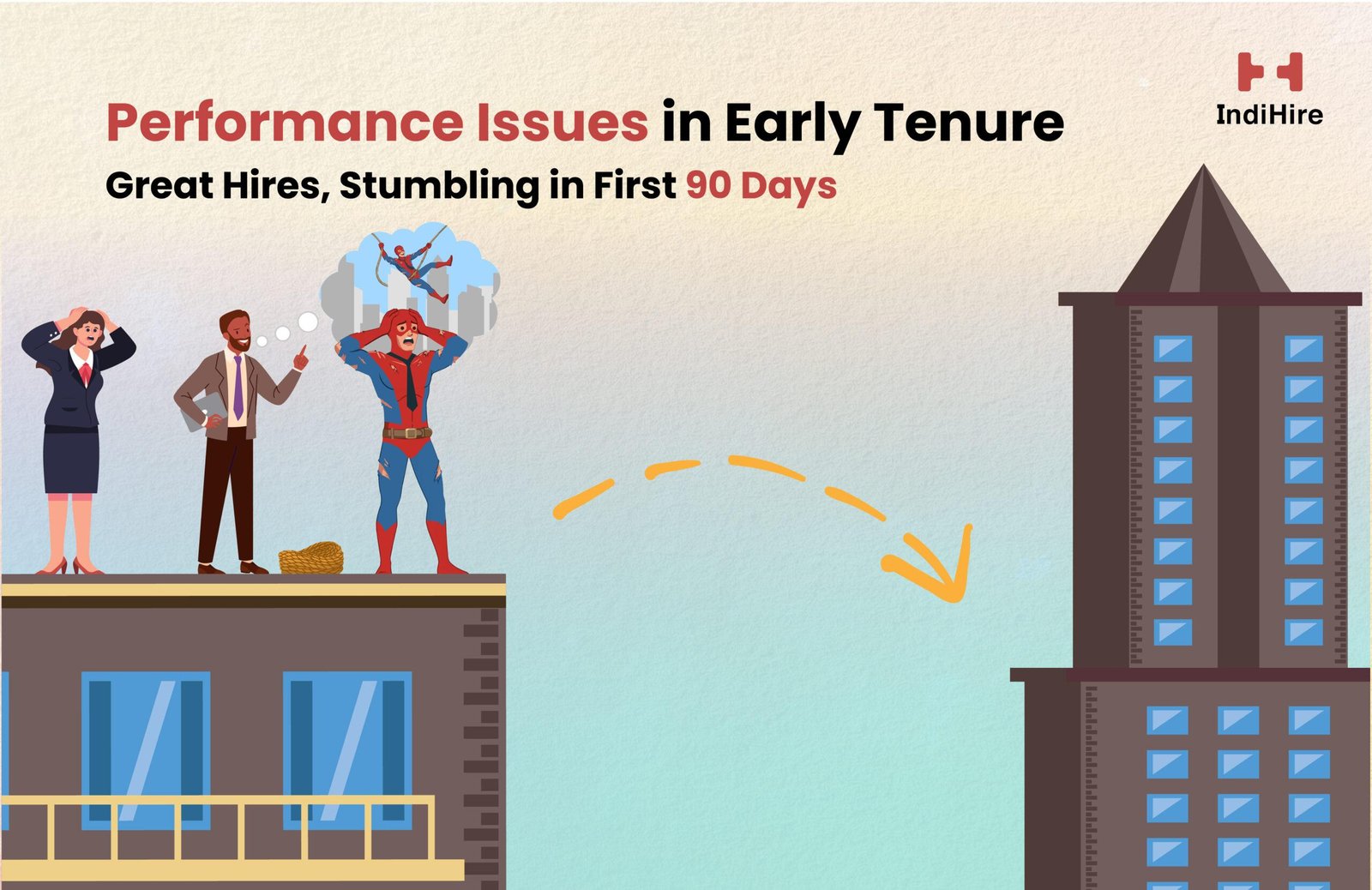
Performance Issues in Early Tenure – Great Hires, Stumbling in First 90 Days
Reading Time: 5 min
You hired someone three months ago. The resume was gorgeous. The pedigree checked every box. The interview? One of the best. You were practically doing a little victory lap around the office. And now? Crickets.
The impact you were promised has not shown up. The metrics look fine, at best. And you are sitting there wondering, did I misjudge this person, or did something go wrong along the way?
The truth is that performance issues in early tenure are one of the most common, most fixable problems in the workplace. Everyone loves discussing “quiet quitting” and “the great resignation”. But this quieter, earlier crisis? It barely gets highlighted.
So, let’s actually dig into this. And the journey between “we hired well” and “why is this not working?”
First, Let’s Kill a Myth
A lot of leaders assume that if someone underperforms early, it is a hiring mistake. Back to the drawing board, right? Not so fast.
More often than not, it is not a who problem. It is a what happened after problem.
Think about it like planting a tree in great soil and then forgetting to water it for three months. The soil was not the issue. The neglect was.
Reason #1: They Do the Work, But Do Not Know It Matters
Does your new hire know what happens if they do not do their job well? Not in a scary way – in a “this matters” way.
New employees, especially the sharp, ambitious ones, want to feel like their work is connected to something bigger than a spreadsheet cell. When all they see is a task list, motivation quietly evaporates. When they see the ripple effect – how their work moves the business, the team, the client relationship – something shifts.
What to do about it:
- Show them the “why” behind the “what”.
- Connect their individual output to a real outcome – a client win, a process improvement, a number that moved because of them.
- Celebrate small wins loudly. Early tenure is fragile – validation goes a long way.
People do not rise to the occasion of a task. They rise to the occasion of meaning. Give them that, and watch the magic happen.
Reason #2: Expectations Were Assumed, Not Set
How many managers actually sit down and spell out, in specific detail, what “good” looks like in the first 90 days?
Not many. Most managers assume the new hire will “figure it out”. After all, they were hired because they are smart, right? But smart does not mean psychic.
Vague expectations are like giving someone a map with no destination marked. They will wander. They might even wander confidently – which is somehow worse, because now you have got confident wandering instead of confused wandering.
Fix this with:
- Crystal-clear KPIs from day one – not “do well”, but “hit X by week 4, Y by week 8”.
- A structured check-in schedule (weekly in month one, biweekly after) – not a vague “let’s touch base sometime”.
- An open feedback loop where issues get flagged early, not during a quarterly review that feels like an ambush.
Clarity is not micromanagement. Clarity is kindness.
Reason #3: Skill Gaps Nobody Talks About
Sometimes the new hire simply does not know the tool, the system, or the process you are using – and they are too proud (or too shy) to say so.
Nobody wants to raise their hand in week two and say, “Hey, I have actually never used this platform before”. It feels like admitting defeat before the game has even started. So instead, they quietly Google their way through it, hoping nobody notices the delay.
But you notice. It just looks like underperformance instead of what it actually is – a learning curve wearing a disguise.
What actually helps:
- Build in a genuine onboarding runway for tools and systems, not just culture and values.
- Create a safe space where “I do not know this yet” is not a confession – just information.
- Pair new hires with a peer buddy who has seen the same learning curve and lived to tell the tale.
Reason #4: Guesswork Instead of Conversation
This might be the biggest one, and it is almost embarrassingly simple: most performance issues get worse because nobody actually talked about them.
Managers guess. “Maybe they are just not that motivated.” Employees guess. “Maybe my manager thinks I am not smart enough.” And everyone quietly spirals in their own head while the actual problem sits there, untouched, growing bigger with every silent week.
Communication is not a soft skill here – it is the whole game.
Try this instead of guessing:
- Ask directly: “What’s getting in your way right now?”
- Create regular, low-stakes conversations – not just formal reviews, but casual “how is it going, really?” chats.
- Notice the things not said as much as what is. Hesitation is data too.
If performance is lacking, intentional, honest conversation is the fastest way to find out why – and, more importantly, the fastest way to fix it before it becomes a bigger, messier issue with an exit interview attached.
Wrapping It Up
So, when performance stumbles, the more useful question is not “did we hire wrong?” It is “did we set them up right?”
Next time you find yourself staring at an underwhelming 90-day review, wondering where it all went sideways – pause before you write it off as a bad hire.
Ask instead: did we give them purpose, clarity, skills, and honest conversation?
If the answer is “not really”, well – the good news is that it is fixable, starting today.
What’s one thing you could change this week for a new hire on your team? Start there. Small, intentional moves add up faster than you would think – and your results will speak for themselves.


© 2026 IndiHire.