The Day Humans Compete with Their AI Twins for Jobs
Reading Time: 5 min
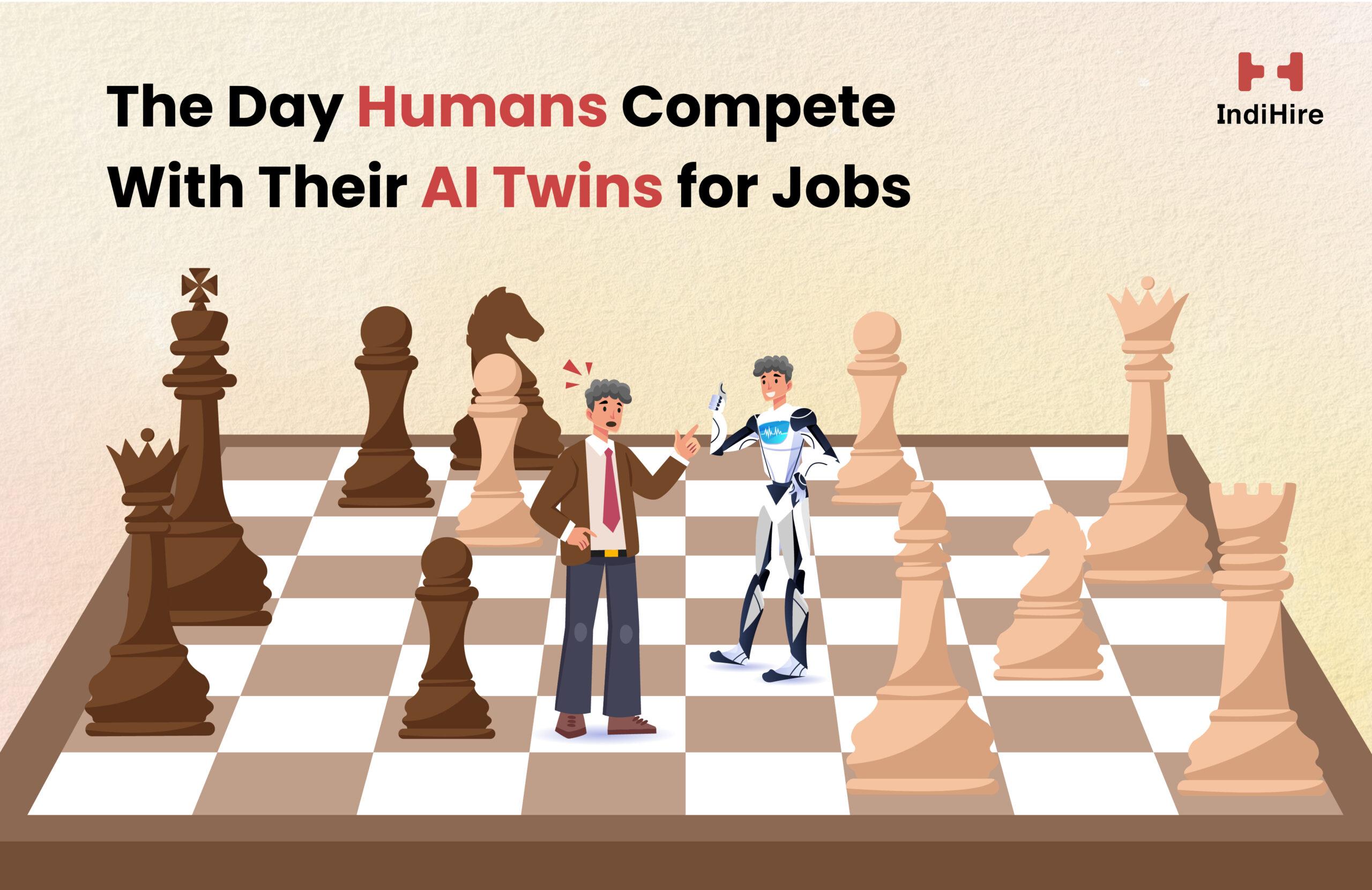
You walk into the office on a Monday morning, coffee in hand, ready to tackle your inbox. And there, sitting in your virtual seat, is you. Same thinking patterns. Same writing style. Same ability to finish your own sentences. Except this version of you never sleeps, never takes a coffee break, and definitely never asks for a raise.
That is the world of AI digital twins. Sounds like a sci-fi script, except, it is not. It is happening right now, in 2026, in boardrooms and HR systems you would recognise.
So, let’s ask the uncomfortable question out loud: are we actually about to compete with ourselves for our own jobs?
What Exactly Is a Digital Twin?
Think of a digital twin as a highly caffeinated understudy that has been shadowing you for months. Except instead of taking notes, it has been learning from your meetings. From the way you write emails and your decision-making patterns. And also, from your general “vibe” at work. Analysts describe it as a language model trained on an individual’s meetings, calls, documents, and presentations, then fine-tuned to mimic how that person actually thinks and solves problems.
This is not some fringe idea either. Major organisations have identified digital twins as one of the core future-of-work trends. The overwhelming majority of industry leaders are already piloting or deploying generative AI tools, with most planning to roll out agentic AI in the coming few years. Digital twins are simply next on the agenda.
But Are the Robots Actually Coming for Our Jobs?
Here’s where it gets interesting – and where the headlines tend to get it wrong.
The numbers are real. According to Goldman Sachs, net AI-driven job losses in the US were around 16,000 positions a month, and Stanford’s 2026 AI Index found employment for software developers ageing 22 to 25 years has dropped nearly 20% since 2024. While the demand for more experienced developers keeps climbing.
As per the World Economic Forum, AI and automation could displace over 92 million jobs by 2030 globally – but also create well over 170 million new ones in the same stretch.
Confusing? A little. But here’s the pattern hiding underneath all that noise: AI is not mainly deleting jobs that exist. It is quietly suppressing the creation of new ones, especially at entry level, while reshaping what the jobs that remain actually look like. That’s a very different problem than “the robots took my job”, and it is the one TA leaders actually need to be planning for.
What Your AI Twin Still Cannot Do
Your digital twin might write your emails, sit through your status meetings, and even mimic your Slack tone disturbingly well – but it still cannot be you where it counts.
It cannot read the room when a teammate is quietly burning out. It cannot make the judgment call to bend a policy for a genuinely unusual situation. It cannot build trust with a nervous new hire on their first day or talk a client off the ledge during a crisis nobody planned for. It does not feel accountable for anything, because it is not.
AI is extraordinary at pattern recognition and repetition. Humans are still unmatched at:
- Judgment under ambiguity – when the data runs out, and someone has to just decide.
- Creativity that breaks the pattern rather than remixing it.
- Emotional intelligence – reading tone, trust, and tension in a room.
- Accountability – someone must own the outcome, and it cannot be a machine.
So no, this is not really humans versus AI twins in a cage match. It is more like humans plus AI twins, running a very strange three-legged race together.
What This Means for Recruitment
For TA leaders, this shift is not theoretical – it is already showing up in headcount plans and job descriptions. A few things worth sitting with:
- Roles are being redesigned, not deleted. Expect more hybrid job descriptions where “manage your AI twin’s output” is quietly part of the role.
- Entry-level hiring is the real pressure point. With junior developer employment already sliding, TA teams need fresh thinking on how early-career talent builds experience when AI is doing the “easy reps”.
- New skills are entering the JD. Prompting, AI oversight, and knowing when not to trust the model are becoming as core as Excel once was.
- Governance just became an HR job. Who owns a digital twin’s output? Its mistakes? Its data? Courts and regulators are leaning toward treating it like any other tool the employer relies on – which means the responsibility does not disappear – it concentrates.
Recruiters themselves are not exempt, either. Many are already running their own “AI twins” quietly in the background to handle sourcing and scheduling grunt work, freeing up real hours for the parts of the job that actually need a human – relationship-building and judgment calls on culture fit.
So, Will We Really Compete with Our AI Twins?
Think of it less as competition and more like a very intense co-pilot relationship – one where your twin handles the repetitive 80%, and you get to spend more of your energy on the 20% that actually needs a human pulse behind it.
The organisations that win this decade will not be the ones that replace people with digital twins, or the ones that ignore the technology out of fear. They will be the ones that figure out, deliberately and early, how humans and their AI twins divide the work – and who ultimately stays accountable when it matters.
So, if your digital twin showed up to work tomorrow, would it make you look better, or would it expose exactly which parts of your job were never really about you in the first place?


© 2026 IndiHire.